International Glance
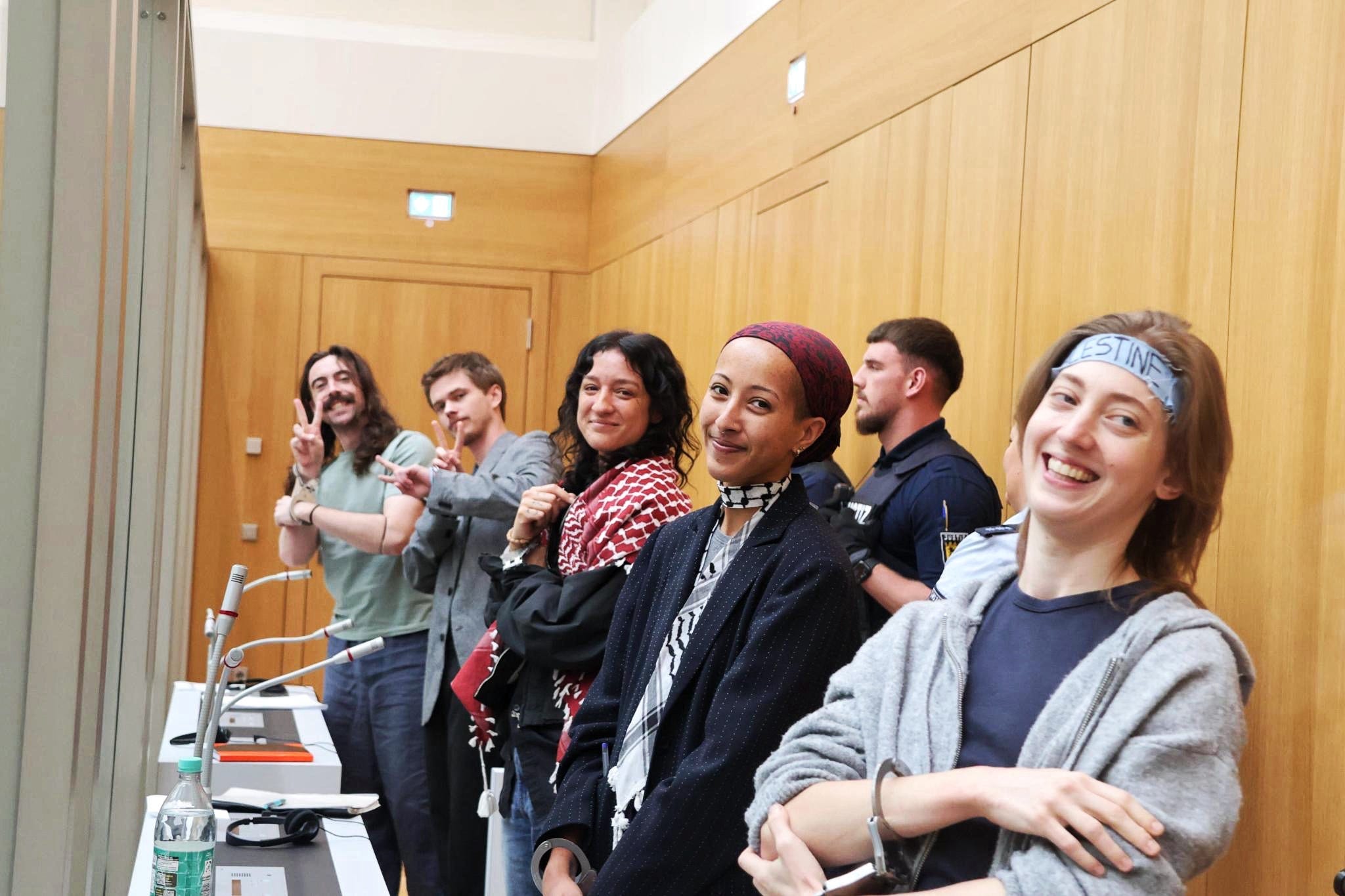 Nearly fifty years after the infamous Red Army Faction trials, Germany’s maximum-security Stammheim Prison is once again the setting of a high-profile case that calls into question the conduct of the German state. This time, however, the defendants are five international pro-Palestinian activists charged with vandalizing a factory in the German city of Ulm owned by Israeli weapons manufacturer Elbit Systems.
On September 8, 2025, the five Berlin-based activists, now known as the Ulm 5, broke into Elbit’s facility and carried out acts of vandalism that they recorded using body cameras and posted online. They destroyed equipment and spray painted “free Palestine” and “baby killers” on the walls. In their videos, the activists—citizens of Britain, Ireland, Spain, and Germany—say they carried out their direct action “to dismantle the tools used to commit genocide in Gaza” and to call attention to Germany’s complicity with it.
No one was injured in the action, which allegedly caused €1.04 million in damages, and the protesters remained at the scene to be arrested. Even so, German prosecutors have clearly decided to treat the Ulm 5 with unusual severity, charging them with membership in a criminal organization, Palestine Action Germany, in addition to trespassing and criminal damage. An additional charge concerns the use of “symbols of an unconstitutional or terrorist organisation”—referring to Hamas—based on the defendants’ use of slogans including “From the river to the sea, Palestine will be free.”
The courtroom itself has been staged for maximum drama, as if the proceedings concerned dangerous criminals rather than nonviolent protesters. The five defendants sit behind a double layer of bulletproof glass that separates them from both their legal team and the public gallery.
 Israel plans to seek additional US weapons and defence capabilities as "compensation" after Washington approved the potential sale of F-35 fighter jets to Saudi Arabia, Israeli media has reported.
 Denmark’s government was cautiously optimistic on Saturday following Donald Trump’s announcement of a deal on Greenland to bolster U.S. military presence there but keep the island under Danish control, after months of threats by the U.S. president to seize the semiautonomous territory of a NATO ally.
 When Israel deployed its Iron Beam laser weapon for the first time last December, the announcement by leading Israeli defense firms Rafael and Elbit Systems was met with fawning coverage worldwide. The futuristic laser system, designed to shoot drones and rockets out of the sky, was celebrated as a demonstration of the Israeli weapons industry’s technological sophistication.
 At least 10 people were injured, including a 10-year-old girl, according to the Kyiv City Military Administration.
 The human rights lawyer Noura Erakat was arrested on Tuesday at a Palm Beach county, Florida, budget hearing about the county’s more than $1bn investments in Israeli bonds.
 Russia’s intelligence services are plotting to carry out targeted killings in the United States and in European nations supporting Ukraine, federal authorities said Tuesday as they announced charges against five people who remain at large.