War Glance
 Lebanese farmer Saleh* woke up before dawn on 3 September to harvest his fig trees in the southern Lebanese border village of Halta.
When he stepped out and saw lights outside his neighbours' house, abandoned during the war, Saleh knew an Israeli army unit was there.
The Israeli soldiers were searching houses in the village and called three residents on their mobile phones instructing them to come outside.
After several hours of interrogations, they took the three men away, including Hatem Abdel-Aal, a member of the municipal council. The Israeli army returned Hatem at around midnight.
“They told him you have to come to us by foot, without a car,” Saleh told Middle East Eye. “The man followed their instructions and headed their way. He couldn’t refuse.”
Israel uses Lebanese civilians as bargaining chips
Acting Navy secretary says Iran ‘blew the hell out of’ US base in Bahrain: Report
 The acting U.S. Navy secretary Hung Cao said that the Iranian military severely damaged a major Navy installation in Bahrain, acknowledging the extent of damage sustained by the base during the conflict.
“They blew the hell out of Bahrain,” Cao said in an interview with The Epoch Times, which was published Thursday, referring to the Naval Support Activity Bahrain (NASB), which serves as the headquarters for U.S. Naval Forces Central Command and the U.S. Fifth Fleet.
The base has been heavily targeted by Iran after the U.S. and Israel launched airstrikes against the Islamic Republic in late February.
The Navy has relied on NASB as its main logistics hub in the Middle East.
Cao said the Navy is weighing what to do with NASB, including whether to repair the base.
“I have a task force that’s looking at that,” he told the news outlet.
In late August, the Navy’s top officer said it would be a while before the service branch would return to the base, including to retrieve the personal goods from sailors.
US strikes Iran, destroys 5 oil tankers amid escalating war
U.S. military forces destroyed five Iranian crude oil tankers Sept. 8, officials said, the latest in an escalating round of exchanges between the United States and Iran.
The strikes targeted five tankers linked to Iran's Islamic Revolutionary Guard Corps, according to U.S. Central Command, the arm of the military overseeing operations in the Middle East. Central Command shared footage of theThe strikes targeted five tankers linked to Iran's Islamic Revolutionary Guard Corps, according to U.S. Central Command, the arm of the military overseeing operations in the Middle East. Central Command shared footage of the strikes showing the aft, or rear, part of the massive non-military vessels.
Central Command footage of the strikes shows missiles hitting the ships and leaving them in flames. Four of the tankers were located in the Gulf of Oman. The other tanker was in the Persian Gulf near Kharg Island, a well-known Iranian oil depot President Donald Trump has repeatedly threatened to attack.
U.S. forces targeted the vessels in response to two Iranian attacks on a Navy vessel over the past two days, according to Central Command.
Iran claims strike on a U.S. ship in the Strait of Hormuz but the U.S. denies it
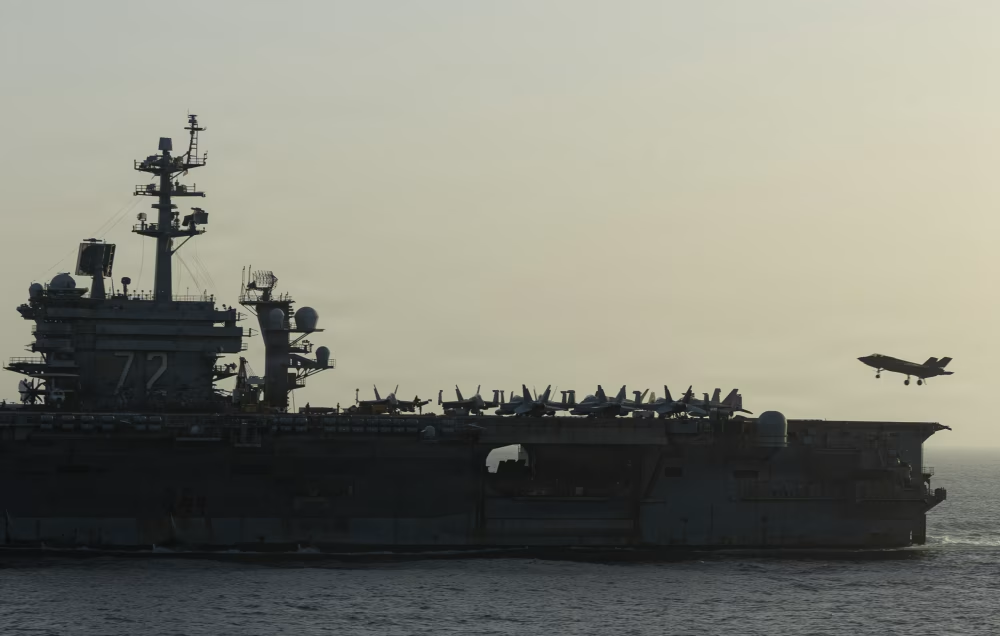 Iran said Sunday it struck an unmanned U.S. vessel trying to enter the Strait of Hormuz, a claim that the U.S. military dismissed as a “total lie.”
The purported attack came a day after the U.S. military said forces struck three Iranian oil tankers in response to Navy warships being targeted with ballistic missiles. Experts called it a dangerous escalation after Iran’s previous attacks at sea targeted commercial shipping.
The war began with U.S. and Israeli attacks on Iran on Feb. 28. But since a fragile ceasefire agreement was announced in June, on-and-off fighting has persisted, with both sides trying to inflict military and economic pain as negotiations have collapsed.
The United States and Iran resumed attacks last week, following a month of relative calm, with the Strait of Hormuz and areas along Iran’s southern coast again being targeted. At least five people were killed earlier in the week during a U.S. bombardment that returned attention to the area where a school was hit in the war’s opening strikes.
U.S. strikes Iranian oil tankers in retaliation for missile attacks on Navy ships
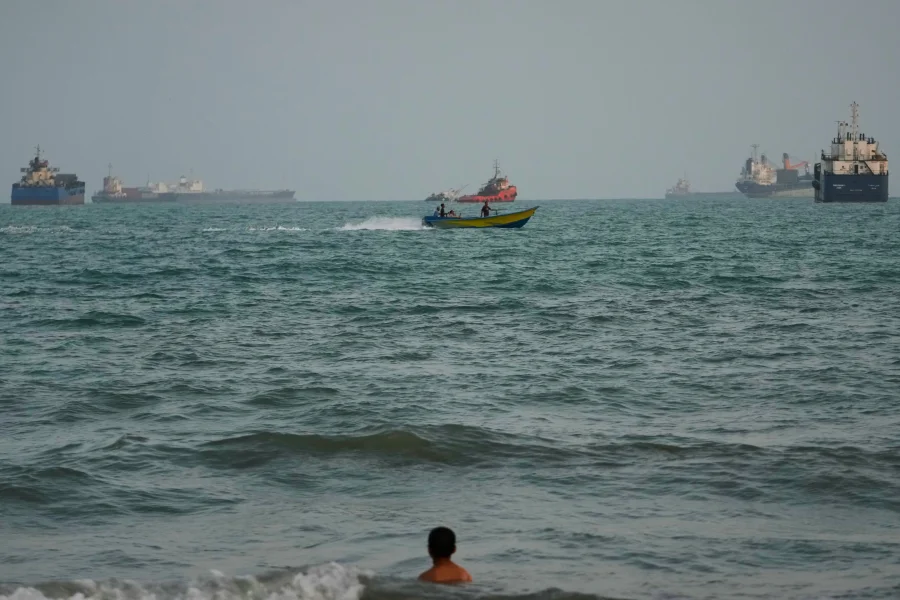 The U.S. military on Saturday said it struck three Iranian oil tankers after Navy ships were targeted by missiles.
U.S. Central Command said it struck the vessels after Iran's Islamic Revolutionary Guard Corps (IRGC) launched two ballistic missiles at two Navy warships patrolling the sea. CENTCOM said a U.S. aircraft carrier and missile destroyer "successfully evaded multiple unprovoked Iranian attacks" and that no American personnel were injured.
"Let the message to the IRGC be clear: If you shoot at two of our ships, we will impose an even higher economic cost —taking out three of yours," CENTCOM Commander Adm. Brad Cooper said in a statement posted on social media. "We will not hesitate to defend American forces, and if necessary, destroy Iran's limited and exposed oil fleet."
US carries out first strike on Iran since July
 The US Central Command (Centcom) said it targeted Iran as it posed an "imminent threat" in the Strait of Hormuz.
In a post on X, Centcom described Iranian accusations against Washington saying it committed an act of aggression as "absolutely FALSE".
"U.S. forces took limited, precise action against IRGC minelaying forces posing an imminent threat in the Strait of Hormuz," Centcom wrote.
"In essence, Iran created the threat and the U.S. military eliminated it to protect civilian mariners, commercial shipping, and the free flow of global commerce."
The statement comes after US forces targeted two launchers on Iran's Larak island late on Sunday, marking the first known American attacks on the country since late July.
Trump warns US will 'bomb shit out of' Oman if it strays from Washington's line on Iran
 US President Donald Trump has threatened to bomb Oman if it “gets in the way” of Washington’s efforts to reach a deal with Iran over the Strait of Hormuz, according to Fox News.
Fox reporter Trey Yingst said he asked Trump about parallel talks between Iran and Oman over control of the Strait of Hormuz.
According to Yingst, Trump responded: “If Oman gets in the way, we’ll bomb the shit out of them.”
The threat comes as Iran and Oman say they have reached an understanding on a maritime transit route through the Strait of Hormuz and are working to finalise details for a joint statement.
Iran and Oman continued talks on Monday, Iranian foreign ministry spokesman Esmaeil Baghaei said, adding that there had been security complications caused by US and Israeli military actions.
“Drawing up the maritime transit route plan with Oman has been time-consuming due to security complexities,” Baghaei said, adding that “the issue is inherently complex”.
Speaking on the proposed mechanism, Baghaei said it would aim to protect the sovereign rights and interests of both Iran and Oman while ensuring the safe passage of commercial vessels.
“This is the first time that a mechanism is being developed to simultaneously safeguard the sovereign rights of the two littoral states and ensure the safe passage of commercial vessels,” he said, adding that intensive talks to finalise a joint statement were continuing.
More Articles...
- ‘They’re all catastrophic’: The paediatric war wounds Dr Abu Sittah tries to heal in Lebanon
- Israel rejects Trump's 15-point plan for Gaza, says Netanyahu
- Three Palestinians killed and dozens wounded in Israeli attacks across Gaza and West Bank
- Iran ‘surprise attack’ ends ceasefire; US retaliates. What's next in the war
Page 1 of 118