

 Five years after he declared victory in Iraq on the US aircraft carrier USS Lincoln, President George W. Bush says he was "unprepared" for a war in Iraq that has gone on to claim thousands of American lives and tens of thousands of Iraqis.
"I wish the intelligence had been different, I guess," Bush tells ABC's Charlie Gibson in an interview to be broadcast tonight, and said he didn't know if he'd have gone to war if he didn't think there were weapons of mass destruction in Iraq.
"That is a do-over that I can't do," Bush said.
Bush: 'I was unprepared for war'
Luxury Shame
Across America's upper strata, rich folk like Hirtenstein are experiencing an unfamiliar emotion: luxury shame. The late Coco Chanel, doyenne of 20th century fashion, long ago said that luxury is "the opposite of vulgarity," not of poverty. But in these recessionary times, it seems vulgar to flaunt one's luxurious lifestyle. And so the wealthy are going blingless and eschewing the spending sprees of the recent Gilded Age, giving new meaning to the phrase "embarrassment of riches."
US diluted loan rules before crash
The Bush administration backed off proposed crackdowns on no-money-down, interest-only mortgages years before the economy collapsed, buckling to pressure from some of the same banks that have now failed. It ignored remarkably prescient warnings that foretold the financial meltdown, according to an Associated Press review of regulatory documents.
Pentagon to Detail Troops to Bolster Domestic Security
The U.S. military expects to have 20,000 uniformed troops inside the United States by 2011 trained to help state and local officials respond to a nuclear terrorist attack or other domestic catastrophe, according to Pentagon officials.
The long-planned shift in the Defense Department's role in homeland security was recently backed with funding and troop commitments after years of prodding by Congress and outside experts, defense analysts said.
Press and "Psy Ops" to merge at NATO Afghan HQ: sources
The U.S. general commanding NATO forces in Afghanistan has ordered a merger of the office that releases news with "Psy Ops," which deals with propaganda, a move that goes against the alliance's policy, three officials said.
The move has worried Washington's European NATO allies -- Germany has already threatened to pull out of media operations in Afghanistan -- and the officials said it could undermine the credibility of information released to the public.
I'm Still Tortured by What I Saw in Iraq
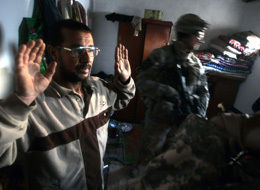 I'm not some ivory-tower type; I served for 14 years in the U.S. Air Force, began my career as a Special Operations pilot flying helicopters, saw combat in Bosnia and Kosovo, became an Air Force counterintelligence agent, then volunteered to go to Iraq to work as a senior interrogator. What I saw in Iraq still rattles me -- both because it betrays our traditions and because it just doesn't work.
Spanish government to probe Guantanamo flights
Spain will investigate whether a previous government allowed Spanish territory to be used to transport captured terrorism suspects to Guantanamo Bay, the Foreign Ministry said Sunday. The ministry said in a statement it had not been informed whether the government of Jose Maria Aznar, in power from 1996 to 2004, allowed CIA flights carrying captured foreigners to use Spanish air space or runways.
The newspaper El Pais said in a report Sunday that it had obtained a government document showing that a U.S. official asked the Foreign Ministry for such access in January 2002. El Pais published the document — labeled MUY SECRETO, or top secret — in its paper and Web site editions.
You Cannot Pardon a Crime You Authorized
Statement from the Steering Committee for the Prosecution for War Crimes of President Bush and His Subordinates
Never before has a president pardoned himself or his subordinates for crimes he authorized. The closest thing to this in U.S. history thus far has been Bush's commutation of Scooter Libby's sentence. Bush is widely expected to follow that commutation with a pardon. Not only did Libby work for the White House, but he was convicted of obstruction of justice in an investigation that was headed to the president. Evidence introduced in the trial, including a hand-written note by the vice president, implicated Bush, and former press secretary Scott McClellan has since testified that Bush authorized the exposure of an undercover agent, that being the crime that was under investigation.
One man's military-industrial-media complex
In the spring of 2007 a tiny military contractor with a slender track record went shopping for a precious Beltway commodity.
The company, Defense Solutions, sought the services of a retired general with national stature, someone who could open doors at the highest levels of government and help it win a huge prize: the right to supply Iraq with thousands of armored vehicles.
Page 1040 of 1167