Environmental Glance
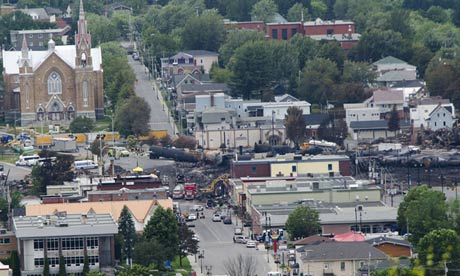 Five days after a train carrying crude oil derailed and exploded in Lac-Mégantic, Quebec, the rural town resembles a scene of desolation. Its downtown is a charred sacrifice zone. 50 people are likely dead, making the train's toll one of the worst disasters in recent Canadian history.
In the explosion's aftermath, politicians and media pundits have wagged their finger about the indecency of "politicising" the event, of grappling with deeper explanations. We can mourn, but not scrutinise. In April, prime minister Stephen Harper even coined an awkward expression – "committing sociology" – to deride the search for root causes about horrifying events, in the wake of an unrelated, alleged bombing attempt.
Quebec's Lac-Mégantic oil train disaster not just tragedy, but corporate crime
Confirmed: Fracking Triggers Quakes and Seismic Chaos
 Major earthquakes thousands of miles away can trigger reflex quakes in areas where fluids have been injected into the ground from fracking and other industrial operations, according to a study published in the journal Science on Thursday.
Previous studies, covered in a recent Mother Jones feature from Michael Behar, have shown that injecting fluids into the ground can increase the seismicity of a region. This latest study shows that earthquakes can tip off smaller quakes in far-away areas where fluid has been pumped underground.
Fracking waste fluids "kind of act as a pressurized cushion," said a lead author on the study.
An Open Letter to President Obama from Gasland Director Josh Fox
 I write to request a meeting with you and families directly impacted by oil and gas drilling and fracking—as documented in Gasland Part II—together with a small group of scientists and engineers who are also featured in the film.
We would like to discuss health and economic impacts felt by communities located near the oil and gas fields, share our first-hand stories, and provide you with evidence on rates of well leakage, water contamination, air pollution and methane emissions.
US system for flagging hazardous chemicals is widely flawed
A 27-year-old U.S. program intended to warn the public of the presence of hazardous chemicals is flawed in many states due to scant oversight and lax reporting by plant owners, a Reuters examination finds.
Under the federal Emergency Planning and Community Right-to-Know Act, private and public facilities must issue an inventory listing potentially hazardous chemicals stored on their properties. The inventory, known as a Tier II report, is filled with state, county and local emergency-management officials. The information is then supposed to be made publicly available, to help first responders and nearby residents plan for emergencies.
Must-See Gasland Part II on HBO Monday: Natural Gas, Once A Bridge, Now A Gangplank
If you liked the Oscar-nominated fracking exposé “Gasland” by Josh Fox, you’ll love the sequel Gasland, Part II, which is being broadcast on HBO Monday night.
I think it’s a better movie, more entertaining and even more compelling in making a case that we are headed on a bridge to nowhere — a metaphorical gangplank — with our hydraulic fracturing feeding frenzy.
Future generations living in a climate-ruined world will be stunned that we drilled hundreds of thousands of fracking and reinjection wells:
World suffered unprecedented climate extremes in past decade: WMO
 The world suffered unprecedented climate extremes in the decade to 2010, from heatwaves in Europe and droughts in Australia to floods in Pakistan, against a backdrop of global warming, a United Nations report said on Wednesday.
Every year of the decade except 2008 was among the 10 warmest since records began in the 1850s, with 2010 the hottest, according to the study by the World Meteorological Organization (WMO). The number of daily heat records far outstripped lows.
Fervent foes devote their lives to fracking fight
 Big energy companies have been trying for five years to tap the riches of the Marcellus Shale in southern New York, promising thousands of new jobs, economic salvation for a depressed region, and a cheap, abundant, clean-burning source of fuel close to power-hungry cities. But for all its political clout and financial prowess, the industry hasn't been able to get its foot in the door.
One reason: Folks like Sue Rapp and Vera Scroggins are standing in the way.
More Articles...
Page 68 of 204