


 “Thank you, thank you!” Luz Maria Villanueva’s voice was choked with emotion at a rally on her front lawn organized by Congressman Bob Filner (D-San Diego). Nearly 100 people turned out at 5:30 a.m. for a candlelight vigil to protest Union Bank’s announced plan to have the Sheriff’s department take Villanueva’s Bonita home. She has pleaded for a reprieve at least until her young son, who has cancer, completes chemotherapy treatments.
Congressman Filner Risks Arrest, Organizes With Residents, to Block Foreclosure
Pope's visit: Catholic abuse survivors demand justice
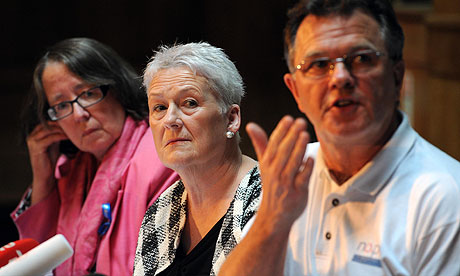 Survivors of abuse within the Roman Catholic church repeated their demand that the pope hand over all information on abusive clergy, in advance of his arrival in the UK tomorrow on a controversial state visit.
They told a press conference in central London today that repeated apologies meant nothing and they wanted "truth, justice and accountability". Peter Saunders, a survivor of Catholic abuse who is now the chief executive of the National Association for People Abused in Childhood (Napac), said: "We need the pope to say, 'I will hand over all the information I have about abusing priests wherever they are in the world. I will hand it over to the authorities of the countries where these people are being protected.'"
Georgia Man Fined $5000 for Growing Vegetables
 A Georgia resident who has been an organic farmer for years is now facing $5000 dollars in fines for growing too many vegetables on his OWN land. That’s right.
Steve Miller, who has sold some of his produce at local farmers markets, as well as growing food for himself, is likely the victim of an Online Aerial Invasion of Private Property. This invasion of property is probably due to the fact that unless visited or inspected by an official, there would be no way for there to be an accurate or factual accounting of what was going on at Mr. Millers property. The question is, “Does Steve Miller legally posses a reasonable expectation of Privacy on his own Private Property?
Analysis: How UK armed Saddam in 80s
 The United Kingdom was directly involved in arms trade with both parties during the war, however the British government kept a blind eye to evident illegal exports taking places between numerous British companies and Saddam Hussein's regime, making Iraqi clandestine procurement operations very active within the United Kingdom.
The UN Security Council had identified and listed 150 foreign companies whom supported and facilitated Saddam Hussein's program for weapons of mass destruction during the Iran-Iraq war. 24 of these companies were British.
A Medal for War Crimes
 Tony Blair, the war criminal of Iraq, Afghanistan and the Middle East and former prime minister of the UK, was awarded last night Sept. 13 2010 the “Liberty Medal” at the National Constitution Center in Philadelphia by the famous protagonist of many sex scandals in the White House, former President Bill Clinton. the chair of the NCC joined thw president while awarding the disgraceful Bliar in ignorance of the scene of last week when he was pelted with shoes, eggs, and beer bottles during the signing of his miserable first book in Ireland, after he left millions of widows orphans behind him in Iraq. The “medal of freedom” is supposedly given to people in recognition of their effort for peace, NOT for war crimes, genocide, crimes against humanity, corruption and thievery. This award was established in 1988 on the bicentennial anniversary of the proclamation of the US Constitution, and until now it has been given ONLY to war criminals from the US and its allies.
Another signing event of Blairs book was canceled in London due to the huge protest against his crimes. Blair brought disaster to the humanity and is still committing genocidal crimes in the same way everywhere he puts his feet.
A New Name for High-Fructose Corn Syrup
 The Corn Refiners Association, which represents firms that make the syrup, has been trying to improve the image of the much maligned sweetener with ad campaigns promoting it as a natural ingredient made from corn. Now, the group has petitioned the United States Food and Drug Administration to start calling the ingredient “corn sugar,” arguing that a name change is the only way to clear up consumer confusion about the product.
“Clearly the name is confusing consumers,” said Audrae Erickson, president of the Washington-based group, in an interview. “Research shows that ‘corn sugar’ better communicates the amount of calories, the level of fructose and the sweetness in this ingredient.”
Over-the-Counter Cough Medicines Escape FDA Restrictions
 A panel of medical experts says cough medicines like Robitussin should continue to be sold over-the-counter, despite increasing abuse among teenagers that has prompted calls to restrict the products.
The Food and Drug Administration panel voted 15-9 against a proposal that would require a doctor's note to buy medicines containing dextromethorphan, an ingredient found in more than 100 over-the-counter medications.
Israeli rights group: Probe IDF soldiers over deaths of Palestinian civilians
 A new report by the human rights group B'tselem concludes that during the past four years not a single IDF soldier was indicted for killing Palestinian civilians in the territories.
The report claims that between 2006 and 2009, 617 Palestinian civilians not involved in combat operations were killed in the territories - a count that does not include those killed during Operation Cast Lead in the Gaza Strip.
Tightened muzzle on scientists is 'Orwellian'
The Harper government has tightened the muzzle on federal scientists, going so far as to control when and what they can say about floods at the end of the last ice age.
Natural Resources Canada (NRC) scientists were told this spring they need "pre-approval" from Minister Christian Paradis' office to speak with journalists. Their "media lines" also need ministerial approval, say documents obtained by Postmedia News through access-to-information legislation.
Page 745 of 1167