


PolitiFact, the Pulitzer Prize-winning fact-checking website of the Tampa Bay Times, will soon launch PunditFact, a site dedicated to checking claims by pundits, columnists, bloggers and the hosts and guests of talk shows.
PunditFact is being funded by $625,000 in grants over two years from the Ford Foundation and the Democracy Fund. Seed money for the project was provided by craigconnects, a philanthropy group run by Craig Newmark, founder of craigslist.
PolitiFact to launch PunditFact, checking pundits and media figures
Patriot Act author prepares bipartisan bill to curb NSA
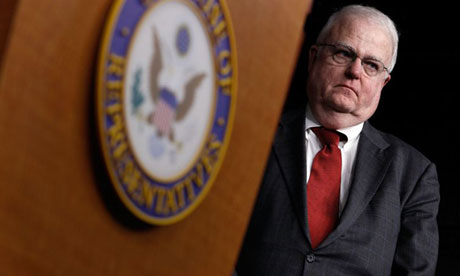 The conservative Republican who co-authored America's Patriot Act is preparing to unveil bipartisan legislation that would dramatically curtail the domestic surveillance powers it gives to intelligence agencies.
Congressman Jim Sensenbrenner, who worked with president George W Bush to give more power to US intelligence agencies after the September 11 terrorist attacks, said the intelligence community had misused those powers by collecting telephone records on all Americans, and claimed it was time "to put their metadata program out of business".
Nuclear power: why US nuclear 'renaissance' fizzled and plants are closing
 A funny thing happened on the way to a nuclear renaissance: For the first time in 15 years, operating nuclear plants are being forced to close, and energy companies are scuttling plans for new plants and upgrades to existing ones.
In addition to four closures of nuclear plants so far this year, two other US nuclear plants are at a crossroads, and dozens more at risk of early retirement.
16-year-old Malala Yousafzai wins Sakharov Prize for Freedom of Thought
 Pakistan's Malala Yousafzai has won the European Parliament's Sakharov Prize for Freedom of Thought.
Parliament President Martin Schulz called the 16-year-old a "brave advocate for education" who "reminds us of our duty toward children and especially girls." The prize is worth about $67,000.
Lonely planet without a star discovered wandering our galaxy
 An exotic young planet free-floating through the Milky Way galaxy rather than orbiting any star is practically a newborn in cosmic terms, astronomers say.
Dubbed PSO J318.5-22, the planet without a host star is 80 light-years away from Earth and has a mass only six times that of Jupiter. It formed a mere 12 million years ago, researchers said -- a newborn in planet lifetimes.
The Kochs Can't Control the Monster They Created
 The government shutdown and looming threat of default have pitted House conservatives against the Republican Party's traditional allies in the business community. Populist Tea Partiers driven by ideology care little for the pleas for sanity from banking lobbyists and the Chamber of Commerce; indeed, they wear their disregard for Big Business as a badge of honor.
Where does that leave the Koch brothers? The billionaire industrialists have funded a sprawling empire of libertarian-conservative activism; they've been dubbed the bankrollers of the Tea Party. Liberals frequently accuse them of seeking deregulatory policies to further their company's financial interests. But what happens when the Tea Party's ideological warfare threatens to plunge the U.S. economy into chaos?
Russian parliament to debate law to strip gay parents of custody of their children
 RUSSIAN lawmakers will in February debate a bill that could see homosexual couples lose custody of their children, parliamentary documents showed Wednesday.
The debate will likely coincide with the 2014 Winter Olympic Games in Sochi which have already been marred by boycott calls over Russia's controversial new anti-gay legislation.
Scientists who took chemistry into cyberspace win Nobel Prize
 Three U.S. scientists won the Nobel chemistry prize on Wednesday for pioneering work on computer programs that simulate complex chemical processes and have revolutionized research in areas from drugs to solar energy.
The Royal Swedish Academy of Sciences, awarding the prize of 8 million crowns ($1.25 million) to Martin Karplus, Michael Levitt and Arieh Warshel, said their work had effectively taken chemistry into cyberspace. Long gone were the days of modeling reactions using plastic balls and sticks.
Ex-Chesapeake CEO McClendon raises $1.7 billion to drill in Ohio's Utica Shale
An energy firm run by Aubrey McClendon, the former Chesapeake Energy Corp (CHK.N) chief executive, has raised $1.7 billion to drill on shale acreage in Ohio's Utica Shale, the firm said on Wednesday.
Proceeds will initially be used to acquire and drill on about 110,000 acres in the southern portion of the Utica Shale.
Drilling operations will begin with one rig in the fourth quarter of 2013, and the firm plans to increase drilling activity to at least 12 rigs over the next 2 to 3 years, the firm said.
Page 331 of 1167