

Significant strides in science have been made to better understand potential ground shaking from induced earthquakes, which are earthquakes triggered by man-made practices.
Earthquake activity has sharply increased since 2009 in the central and eastern United States. The increase has been linked to industrial operations that dispose of wastewater by injecting it into deep wells.
The U. S. Geological Survey (USGS) released a report today that outlines a preliminary set of models to forecast how hazardous ground shaking could be in the areas where sharp increases in seismicity have been recorded. The models ultimately aim to calculate how often earthquakes are expected to occur in the next year and how hard the ground will likely shake as a result. This report looked at the central and eastern United States; future research will incorporate data from the western states as well.
Fracking Increases Quakes in 8 States
US law enforcement accused of using entrapment to ensnare ‘terrorists’
 The recent arrests on terrorism-related charges of six young Somali-Americans from Minneapolis and others throughout the United States have prompted renewed questions over the issue of entrapment, and over the degree of real security achieved by disrupting plots that law-enforcement had helped shape.
The six, ages 19 to 21, were charged with conspiracy to aid and support a terrorist organization, and are accused of trying to travel to Syria to join the Islamic State in Iraq and the Levant (ISIL, also called ISIS).
After 9/11, We Were All Judith Miller
If the sales of Judith Miller’s memoir are commensurate with the vituperation of the attacks on her, the royalties will mount. Her critics—they are many and loud—say the former New York Times reporter bears a responsibility for the Iraq war because the articles she wrote in the lead-up to the invasion advanced the Bush Administration’s contention that the country had weapons of mass destruction.
It’s easy to disparage Miller. Too easy. Censure her and we can sidestep looking at our own reporting, at broader disquieting questions about journalism since 9/11. As journalists, we all let our guard down in the aftermath of the worst terrorist attack on American soil. We abandoned some of the most important journalistic principles—speak truth to power; hold governments accountable; display healthy skepticism—at the base of the American flagpole. And I don’t just mean the royal we, the institutional we. I, too, am culpable.
Oklahoma goes from two 3.0 quakes a year to two a day
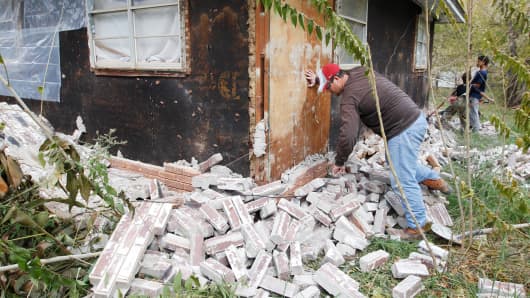 In November of 2011, a magnitude 5.7 earthquake ripped through the small Oklahoma town of Prague, damaging more than a dozen homes and toppling a turret on a St. Gregory's University building in nearby Shawnee.
In November of 2011, a magnitude 5.7 earthquake ripped through the small Oklahoma town of Prague, damaging more than a dozen homes and toppling a turret on a St. Gregory's University building in nearby Shawnee.
Study Links Texas Earthquake Swarm to Natural Gas Drilling
With real-time monitors, scientists have linked a swarm of small earthquakes west of Fort Worth, Texas, to nearby natural gas wells and wastewater injection.
"It's what we figured all along, it's not really new news to us," said Azle Mayor Alan Brundrett, "It's just confirming our suspicious that we've had."
In 84 days from November 2013 to January 2014, the area around Azle, Texas, shook with 27 magnitude 2 or greater earthquakes, while scientists at Southern Methodist University and the U.S. Geological Survey monitored the shaking. It's an area that had no recorded quakes for 150 years on faults that "have been inactive for hundreds of millions of years," said SMU geophysicist Matthew Hornbach.
Blue Bell expands recall to all of its products
 Brenham-based Blue Bell Creameries is pulling all of its products from the shelves after more ice cream samples tested positive for a life-threatening bacterial infection.
The voluntary decision, announced Monday, is the latest and most sweeping development to plague the Texas business icon since a recall last month, the first in the company's 108-year history.
The Terrible Legacy of Agent Orange
I wanted to put it all in the context of today’s Vietnam, forty years on. To see victims of the second and third generations, where and how they live. To learn why children and grandchildren of people affected are still being born with disabilities, to find out if people know about the dangers, and if so when did they found out.
And to take pictures of all that.
As we got closer to the former front lines travelling from the north, the number of cases increased. We kept in touch with VAVA, the main association helping victims, and they gave us much needed information, including the number of victims and where they live.
Oil Services Co.,Baker Huhes, lays off 10,500
 "Extreme market forces" are in play in the global energy sector, oil services company Baker Hughes said Tuesday in announcing widespread layoffs.
The company said it was cutting about 17 percent of its workforce, or around 10,500 jobs, as it works to streamline its finances amid the drop in exploration and production. During the first quarter, Baker Hughes reported revenue of $4.59 billion, a 20 percent decline year-on-year.
"Our first quarter results are a reflection of the extreme market forces faced by our industry since late December," Baker Hughes Chairman and Chief Executive Officer Martin Craighead said in a statement. "Consistent with past downturns, many of our customers have curtailed or canceled projects."
Blood on the tracks: The short life and mysterious death of Deion Fludd
 One evening almost two years ago, a young couple walked hand in hand to a subway station in the Brownsville section of Brooklyn. The girl, Hesha Sanchez, 17, wasn’t carrying her fare card, but she wanted to keep her boyfriend, Deion Fludd, company while he waited for the train. So they squeezed through the turnstile on a single swipe of his card.
Roughly 40 minutes later, Fludd, bloodied and semiconscious, was carried from the station. According to the New York City Police Department, officers tried to arrest Fludd for fare evasion after encountering him on the subway platform. He then fled onto the tracks and was hit by a train. But when Fludd awoke the next day, his ankle shackled to his hospital bed, he told a different story: According to his family, the teenager said he’d been injured by police, who’d beaten him after he climbed back onto the subway platform. Nine weeks later, Fludd died from complications from his injuries.
Page 252 of 1167