Science Glance
 The earliest plants to have colonised land have been found in Argentina. The discovery puts back by 10 million years the colonisation of land by plants, and suggests that a diversity of land plants had evolved by 472 million years ago.
The newly found plants are liverworts, very simple plants that lack stems or roots, scientists report in the journal the New Phytologist. That confirms liverworts are likely to be the ancestors of all land plants.
Fossils of earliest land plants discovered in Argentina
Possible Cause of Bee Die-Off Is Found
 It has been one of the great murder mysteries of the garden: what is killing off the honeybees? Since 2006, 20 to 40 percent of the bee colonies in the United States alone have suffered “colony collapse.” Suspected culprits ranged from pesticides to genetically modified food.
Now, a unique partnership — of military scientists and entomologists — appears to have achieved a major breakthrough: identifying a new suspect, or two. A fungus tag-teaming with a virus have apparently interacted to cause the problem, according to a paper by Army scientists in Maryland and bee experts in Montana in the online science journal PLoS One.
Scientists overcome hurdles to stem cell alternatives
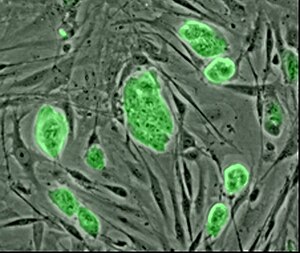 Scientists have invented an efficient way to produce apparently safe alternatives to human embryonic stem cells without destroying embryos, a long-sought step toward bypassing the moral morass surrounding one of the most promising fields in medicine.
A team of researchers at the Harvard Stem Cell Institute in Boston published a series of experiments Thursday showing that synthetic biological signals can quickly reprogram ordinary skin cells into entities that appear virtually identical to embryonic stem cells. Moreover, the same strategy can then turn those cells into ones that could be used for transplants.
Not too hot, not too cold: could the 'Goldilocks' planet support life?
 The search for a faraway planet that could support life has found the most promising candidate to date, in the form of a distant world some 120,000 billion miles away from Earth.
Scientists believe that the planet is made of rock, like the Earth, and sits in the "Goldilocks zone" of its sun, where it is neither too hot nor too cold for water to exist in liquid form – widely believed to be an essential precondition for life to evolve.
Winds could explain Biblical parting of the Red Sea
 Computer simulations show how the movement of wind could have parted the waters of the Red Sea The parting of the Red Sea, as described in the Bible, could have been a phenomenon caused by strong winds, according to new computer simulations.
The account in the Book of Exodus describes how the waters of the sea parted, allowing the Israelites to flee their Egyptian pursuers. Simulations by US scientists show how the movement of wind could have opened up a land bridge at one location.
Tightened muzzle on scientists is 'Orwellian'
The Harper government has tightened the muzzle on federal scientists, going so far as to control when and what they can say about floods at the end of the last ice age.
Natural Resources Canada (NRC) scientists were told this spring they need "pre-approval" from Minister Christian Paradis' office to speak with journalists. Their "media lines" also need ministerial approval, say documents obtained by Postmedia News through access-to-information legislation.
Tiny solar cells fix themselves
 Researchers have demonstrated tiny solar cells just billionths of a metre across that can repair themselves, extending their useful lifetime. The cells make use of proteins from the machinery of plants, turning sunlight into electric charges that can do work. The cells simply assemble themselves from a mixture of the proteins, minute tubes of carbon and other materials.
The self-repairing mechanism, reported in Nature Chemistry, could lead to much longer-lasting solar cells. The design and improvement of solar cells is one of the most vibrant areas of science, in part because sunlight is far and away the planet's most abundant renewable energy source.
More Articles...
Page 48 of 62