Environmental News Archive



 In the next few weeks, the Bush administration is expected to relax environmental-protection rules on power plants near national parks, uranium mining near the Grand Canyon and more mountaintop-removal coal mining in Appalachia.
Bush officials moving fast to cut environmental protections
Plea for more research cash as two billion bees die from rampant disease
 They accused the Government of failing to invest in the research needed to stem diseases and parasites which are now thought to have destroyed one in three bee colonies over the past year.
The British Beekeepers' Association (BBKA) has calculated that up to two billion bees succumbed to sickness between November 2007 and April 2008, with a similar number expected to be wiped out by the end of this winter.
Dick Cheney battles Laura Bush over protecting Pacific Ocean
 On one side is first lady Laura Bush, who according to the Washington Post has asked for two briefings on the issue from the White House staff, and has asked her aides to confer with scientists on how to preserve diverse ecosystems.
On the other side is Vice President Dick Cheney, who along with some officials in the Northern Mariana Islands argues that banning fishing and mineral exploration will hurt the region's economy.
TVNL Comment: Money is the only concern of Dick Cheney. Life itself takes a back seat to money for him.
Ozone hole over Antarctica grows again
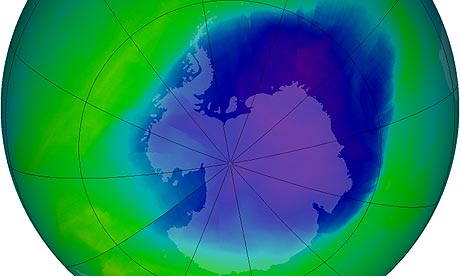 The ozone hole over Antarctica grew to the size of North America this year – the fifth largest on record – according to the latest satellite observations.
US government scientists from the National Oceanic and Atmospheric Administration (NOAA) say this year's ozone hole reached its maximum level on September 12, extending to 10.5m sq miles and four miles deep.
Halloween Trick from Bush Administration: Treat to Factory Farms
housands of factory farms will be exempt from needing permits that limit water pollution thanks to a new Bush Administration rule signed today. In addition, the Environmental Protection Agency did not adopt improved controls for bacteria and other pathogens that can pose risks to human health and wildlife.
Factory farms, also known as concentrated animal feeding operations (CAFOs), confine animals on an industrial scale and produce massive amounts of manure and other waste that can pollute waterways with dangerous contaminants. EPA estimates that these facilities generate three times more waste than people do nationwide. Moreover, factory farms lack waste treatment facilities comparable to those that treat human sewage.
Climate change at the poles IS man-made
 Changes to the climate due to human activity can now be detected on every continent, following a study showing that temperature rises in the Antarctic as well as the Arctic are the result of man-made emissions of greenhouse gases.
It is the first time scientists have been able to prove the link between the temperature changes in both polar regions are down to human activity.
Military Has Key Role to Play in Tackling Climate Change
Military leaders and climate experts from around the world will convene next week in Paris, France for "The Importance of Military Organizations in Protecting the Climate: 2008," on 3-5 November 2008.
This workshop intends to provide a forum for leadership announcements and updates; apply lessons from ozone layer protection to climate protection; highlight challenges and progress made by developed and developing countries; summarize emerging and available climate protection technologies suitable for military and civilian applications; and present case studies of military and commercial leadership to protect the climate.
Read more...
This workshop intends to provide a forum for leadership announcements and updates; apply lessons from ozone layer protection to climate protection; highlight challenges and progress made by developed and developing countries; summarize emerging and available climate protection technologies suitable for military and civilian applications; and present case studies of military and commercial leadership to protect the climate.
Earth on course for eco 'crunch'
 The document contends that our demands on natural resources overreach what the Earth can sustain by almost a third.
It says that more than three quarters of the world's population lives in countries where consumption levels are outstripping environmental renewal.
This makes them "ecological debtors", meaning that they are drawing - and often overdrawing - on the agricultural land, forests, seas and resources of other countries to sustain them.
TVNL Comment: Keep having kids!
Under the radar: Canada's, Mexico's radioactive waste comes into Utah
Federal regulators gave their blessing to low-level radioactive waste from Canada and Mexico that is now buried in Utah.
But Utah never got the memo. Nor did the regional radioactive waste oversight organization Utah belongs to.
That foreign waste could be imported into Utah without the knowledge of state and regional officials might seem hard to believe in such a highly regulated business as radioactive waste. But federal regulators saw no reason to keep Utah in the loop on such small shipments.
More Articles...
Page 151 of 159