


Israel ordered journalists out of areas abutting the Gaza Strip border on Monday, declaring a "closed military zone" there as an offensive in the Hamas-ruled coastal territory entered its third day.
Israel seals off Gaza periphery to journalists
The Bush Plan For 'Peace'
Bush told the world that he wanted to see Peace in the Middle-East before he left office; and now we see exactly what he meant by this bit of Newspeak that is his version of Orwell's "War is Peace."
The fact that Obama will only intensify these kinds of crimes as are being committed by Israel as this is written does not bode well for either Peace or for stability in coming years.
The True Story Behind This War is Not the One Israel is Telling
The world isn't just watching the Israeli government commit a crime in Gaza; we are watching it self-harm. This morning, and tomorrow morning, and every morning until this punishment-beating ends, the young people of the Gaza Strip are going to be more filled with hate, and more determined to fight back, with stones or suicide-vests or rockets. Israel's leaders have convinced themselves the harder you beat the Palestinians, the softer they will become. But when this is over, the rage against Israelis will have hardened, and the same old compromises will still be waiting by the roadside of history, untended and unmade.
Was 2008 the beginning of another Great Depression?
 It wasn't 1929, but like that infamous year, 2008 is sure to be remembered by economic historians as one unlike any other.
"We had a much simpler financial system back then. The number of wild and crazy things that happened this year is completely without precedent in world history,"
Israel Accused Of Massive War Crime Atrocities
 Falk, United Nations Special Investigator for Human Rights in the Occupied Territories, listed numerous actions by Israel that clearly break the rules of engagement codified in the Geneva Conventions.
These include; collective punishment of the 1.5 million inhabitants of the Gaza Strip for the actions of relatively few militants; the indiscriminate targeting of civilians including school children and university students during air strikes, with hundreds now dead or injured; a disproportionate military response which has destroyed every police and security office of Gaza’s elected government.
Israel has also sealed off entry and exit points to the Gaza Strip, causing severe shortages of medicine, food and fuel and hampering efforts to treat victims of the bombing raids.
Thiamine 'reverses kidney damage'
 Doses of vitamin B1 (thiamine) can reverse early kidney disease in people with type 2 diabetes, research shows.
The team from Warwick University tested the effect of vitamin B1, which is found in meat, yeast and grain, on 40 patients from Pakistan.
Child maid trafficking spreads from Africa to US
 The trafficking of children for domestic labor in the U.S. is an extension of an illegal but common practice in Africa. Families in remote villages send their daughters to work in cities for extra money and the opportunity to escape a dead-end life.
Cash-strapped states weigh selling roads, parks
 GOP lawmakers are pushing to privatize the Minneapolis-St. Paul International Airport and the state lottery. Both steps require a higher authority — federal legislation in the case of the airport, a voter-approved constitutional amendment for the lottery. But one lawmaker estimated an airport deal could bring in at least $2.5 billion, and the lottery $500 million.
TVNL Comment: This is all part of the plan. You are watching the ruling elite engineer the completion of the takeover of America. They will own EVERYTHING eventually.
In pictures: Gaza Massacre
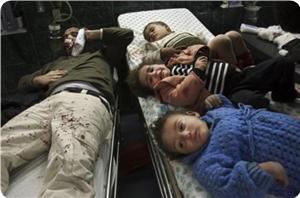 The Israelis killed 150 Palestinians with more expected to die. The Israeli government says it is just the beginning.
Page 1023 of 1167