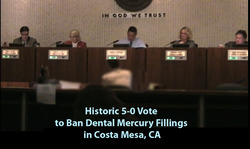
 According to Californians for Green Dentistry, “The mercury implanted into the teeth of unsuspecting patients ultimately ends up back in our environment: (1) in our water via dental clinic releases and household toilets; (2) in our air via cremation, sludge incineration, dental clinic emissions, and human respiration; and (3) in our land via landfills, burials, and fertilizer.”
Dr. Rota went on to say that the diseases which result from the mercury toxicity are not diagnosed by the dentist. They are diagnosed by the physician. Except in acute toxicity cases, when a patient has a conventional blood or urine test, chronic mercury will not be found, as it is trapped in the tissues, and not detected in blood or urine. It wasn’t until chelating agents were developed that enabled the physician to measure and release the mercury.
Mercury is a well-known neurotoxin. Once mercury is discharged to the environment, it converts to methylmercury, a very toxic form, and bio-accumulates in fish. The EPA has designated mercury as its Number One hazardous waste. Amalgam is made up of approximately 40% to 50% mercury, 25% silver, and a 25% to 35% mixture of copper, zinc, and tin.
 After recently gaining recognition as the first professional Santa Claus with Down syndrome in the US,...
 As a new NFL season begins this Wednesday, the danger of America’s most-watched sport has never...