Environmental News Archive



 On July 22, one day after Prime Minister Shinzo Abe’s pro-nuclear Liberal Democratic Party won control of Japan’s upper house of Parliament, the Tokyo Electric Power Company (TEPCO) revealed that contaminated groundwater from its Fukushima Daiichi Nuclear Power Plant was leaking into the Pacific Ocean.
The head of the Soma-Futaba Fisheries Cooperative, Hiroyuki Sato, complained to the local paper, Fukushima Minpo, “TEPCO is saying that the pollution will stay inside the harbor, but the harbor is connected to the ocean, and the tide flows in and out. You can’t say there won’t be any impact. We want them to take action immediately.” The National Federation of Fisheries Cooperative Associations called the
 The state of Texas is in a state of pain.
 An international panel of scientists has found with near certainty that human activity is the cause of most of the temperature increases of recent decades, and warns that sea levels could conceivably rise by more than three feet by the end of the century if emissions continue at a runaway pace.
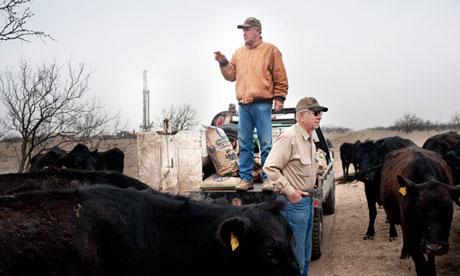 Beverly McGuire saw the warning signs before the town well went dry: sand in the toilet bowl, the sputter of air in the tap, a pump working overtime to no effect. But it still did not prepare her for the night last month when she turned on the tap and discovered the tiny town where she had made her home for 35 years was out of water.
 Beneath the farms, orchards and vineyards of Central and Southern California lies a prehistoric soup worth a fortune. The mineral-rich Monterey and Santos shale formations stretching 1,750 square miles across the San Joaquin Valley and the Los Angeles Basin hold a watery mixture of oil and gas – but it’s the oil that may trigger another gold rush. That is, if companies can figure out a profitable way to tap it.
 A recently published study by researchers at the University of Texas at Arlington found elevated levels of arsenic and other heavy metals in groundwater near natural gas fracking sites in Texas’ Barnett Shale.